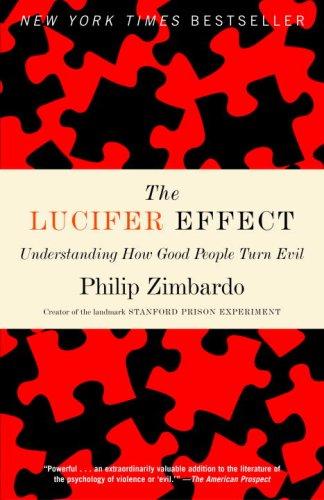
The Lucifer Effect
Below: flat Rs. 199, all Pakistan
Pay when it's in your hand
Master grade quality
Not satisfied? Full refund
Couldn't load pickup availability

The Lucifer Effect by Philip G. Zimbardo explores how ordinary people commit evil acts and how situational forces shape human behavior in ways we rarely acknowledge. Drawing on decades of psychological research - most notably his famous Stanford Prison Experiment - Zimbardo argues that the line between good and evil is far more permeable than we typically assume. The book challenges the notion that wrongdoing stems solely from individual character flaws, instead demonstrating how environmental pressures, social roles, and institutional power can corrupt even well-intentioned people.
Zimbardo examines real-world cases of moral failure, from corporate scandals to military abuses, and traces the psychological mechanisms at work. His central thesis - that "bad apples" are often the product of "bad barrels" - has profound implications for how we understand accountability, justice, and human nature. The book moves beyond mere explanation to offer practical insights on resisting situational influences and building moral resilience in ourselves and our institutions.
This work is essential reading for anyone interested in the intersection of psychology and ethics, providing evidence-based analysis rather than abstract philosophizing. Available nationwide with Cash on Delivery across Pakistan.
- Published: 2007
- Author: Philip G. Zimbardo
- Focus: Situational psychology, moral behavior, institutional influence
- Format: Trade paperback and hardcover editions