
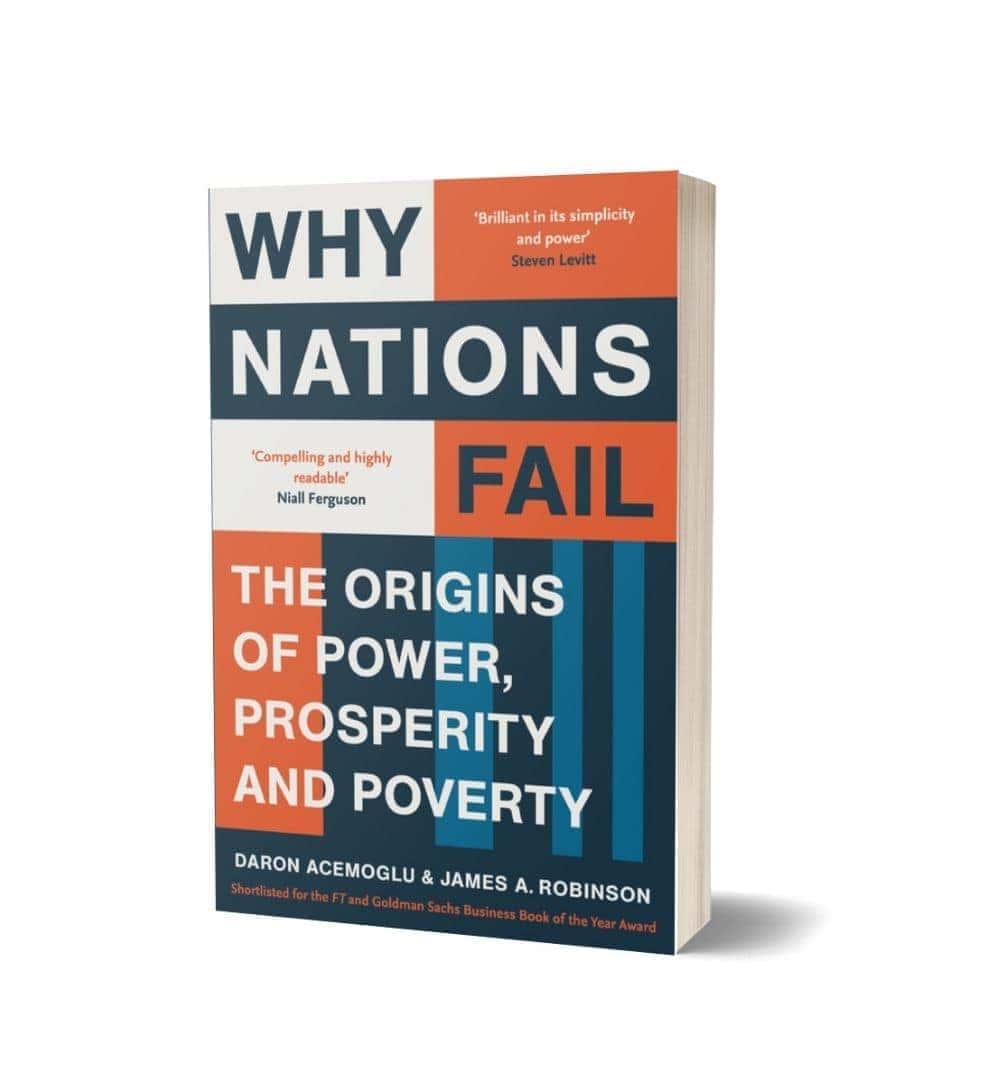
Why Nations Fail: The Origins of Power, Prosperity and Poverty
Below: flat Rs. 199, all Pakistan
Pay when it's in your hand
Master grade quality
Not satisfied? Full refund
Couldn't load pickup availability

Why Nations Fail: The Origins of Power, Prosperity and Poverty by Daron Acemoglu and James Robinson is a work of economic history that traces why some nations prosper while others stagnate or decline. Rather than attributing national success to geography, climate, or cultural factors, the authors argue that institutional frameworks - specifically, whether a society develops inclusive or extractive political and economic systems - determine long-term prosperity.
The book draws on centuries of historical evidence, from the Roman Empire to modern China and the United States, to demonstrate how nations with decentralized power, rule of law, and pluralistic institutions tend to create conditions for sustained growth. Conversely, societies ruled by extractive elites who concentrate wealth and political power inevitably face stagnation and collapse. Acemoglu and Robinson examine critical turning points - the Industrial Revolution, colonial legacies, and the divergence between North and South Korea - to show how institutional choices, often made generations earlier, shape present-day outcomes.
This synthesis of history, economics, and political science has influenced policymakers and scholars across disciplines. The work moves beyond simplistic explanations and demands that readers reconsider conventional narratives about development and inequality. Available across Pakistan with Cash on Delivery, the book arrives at a fair price and can be ordered online for delivery nationwide.
- Explores institutional roots of national success and failure
- Spans Roman history through 21st-century economics
- Challenges geographical and cultural determinism
- Based on rigorous historical and economic research
